Taxes and closing costs when buying a home in Panama in 2026
Published · TuHogar en Panamá
The price of an apartment is not all you will pay. In Panama a purchase triggers two taxes for the seller, several costs for the buyer and, afterwards, a property tax that arrives every year. Here is each one with its official figure, worked examples and what changed in 2026.
In short
- Seller: transfer tax (2 %) and capital gains tax (10 % of the gain or a 3 % advance). Both are filed with the DGI before the sale is registered.
- New homes: since Law 546 of 2026, the first B/.120,000 of a first sale is exempt from transfer tax.
- Buyer: appraisal, lawyer and notary, Public Registry registration and the bank's charges if there is a mortgage.
- Every year: property tax. If it is your main home and you register it as such, the first B/.120,000 of cadastral value is tax-free.
Who pays what in a sale
The general rule is simple: the taxes on the sale belong to the seller, and the costs of formalising your purchase and your loan belong to the buyer. The DGI puts it this way: forms 106 (transfer) and 107 (capital gains) are filed by the seller, who must be registered as a taxpayer.
You still want to understand them. Without those payments the deed is not registered at the Public Registry, and until it is, the home is not yours as far as third parties are concerned. If the promise-to-purchase contract splits the costs differently, ask your lawyer to review that clause before you sign.
Property transfer tax (ITBI): 2 %
The seller pays 2 % on the higher of two values: the sale price or the updated cadastral value. The cadastral value is updated by adding 5 % for each full calendar year the seller owned the property (DGI instructions for Form 106).
Example: a resale apartment sells for B/.180,000 and its updated cadastral value is B/.150,000. The base is B/.180,000 and the tax is B/.3,600.
New in 2026: an exemption for new homes
Law 546 of 31 August 2026 exempts the first B/.120,000 of the first sale of a brand-new home, provided the sale is formalised within two years of the occupancy permit. If the permit was issued before the law, the window is 30 months. Between B/.120,000 and B/.200,000, the excess pays a preferential scale of 0.50 % to 1.80 % depending on the bracket. Above B/.200,000 the first B/.120,000 stays exempt and the rest pays the general rate.
Example: a new B/.250,000 apartment on its first sale pays 2 % only on B/.130,000: B/.2,600 instead of B/.5,000. If you buy off-plan or in a just-delivered project, ask for the date of the occupancy permit: the exemption depends on it and it can matter in the negotiation.
Capital gains: 10 % or a 3 % advance
If selling property is not the seller's regular business, they pay 10 % income tax on the gain (sale price minus cost, improvements and selling expenses). Before the sale is registered they must pay a 3 % advance on the sale price or the cadastral value, whichever is higher, and may keep that 3 % as the final tax. According to the DGI, it is paid before registration at the Public Registry, with the return and the payment in the same month.
With the same B/.180,000 apartment, the advance would be B/.5,400. For you as the buyer, the practical question is who files these forms and when. Usually the lawyer or notary preparing the deed coordinates it.
What the buyer pays at closing
There is no single price list here: every bank, lawyer and notary sets its own. What you can know is the list:
- Appraisal: required by the bank for the mortgage and usually charged separately.
- Lawyer and notary: the public deed of sale and, if there is a loan, the mortgage deed.
- Public Registry: registration fees for the sale and the mortgage.
- Bank charges: a closing or handling fee, depending on the bank. Banks publish them in their fee schedules; we summarise them in our banks guide.
- Loan insurance: banks require borrower life insurance and fire insurance on the home, assigned to the loan. You can use the bank's group policy or, if allowed, assign your own. This is general information, not insurance advice.
Two details that change your payment
FECI. A 1 % annual surcharge on loans over $5,000. A mortgage on your main home does not pay it; one on a second, vacation or investment home does. According to Banco General, foreigners without permanent residency pay it too.
Preferential interest. Law 468 of 2025 replaced Law 3 of 1985. The rate subsidy only applies to a brand-new home of up to B/.120,000 that will be your main residence, for Panamanians or foreigners with permanent residency, once, and only if you have no other home registered. If you are working on your residency, see buying or renting as a foreigner.
After you buy: annual property tax
This is the cost people forget because it comes every year. It is calculated on the cadastral value (not the price you paid), with progressive rates by bracket. These are the DGI's:
| Cadastral value | General rate | Main home or family estate |
|---|---|---|
| Up to B/.30,000 | 0 % | 0 % |
| B/.30,000 to 120,000 | 0.60 % | 0 % |
| B/.120,000 to 250,000 | 0.60 % | 0.50 % |
| B/.250,000 to 500,000 | 0.80 % | 0.50 % |
| B/.500,000 to 700,000 | 1.00 % | 0.50 % |
| Over B/.700,000 | 1.00 % | 0.70 % |
Example: with a cadastral value of B/.200,000, if it is your main home you pay 0.50 % on B/.80,000, or B/.400 a year. If you buy it to rent out, you pay 0.60 % on B/.170,000: B/.1,020 a year.
- The benefit is not automatic. Main-home or family-estate status is requested from the DGI (in e-Tax 2.0), and the law gives it three months to reply.
- Condos (PH) with an improvements exemption: pay 1 % a year on their share of the land value.
- Dates: paid in three instalments (30 April, 31 August and 31 December). Pay the full year before 30 April with no arrears and you get a 10 % discount.
- With a mortgage: the bank can withhold the tax for you.
If you buy in a condo (PH), also add the building's maintenance fee, set by its owners' assembly. Ask for it in writing before you make an offer.
Before you sign: a short checklist
- Get the property certificate from the Public Registry (owner, liens, mortgages). We explain how in official procedures.
- Confirm the property has a DGI tax clearance (paz y salvo): it is required to transfer it.
- Ask for the cadastral value: both the transfer tax and the property tax depend on it.
- If it is new, note the date of the occupancy permit (Law 546 exemption).
- Compare mortgage charges and requirements at several banks.
- Work with a licensed attorney and a broker licensed by the Junta Técnica de Bienes Raíces. If you need a lawyer, you can request a consultation in legal services.
Where to look?
Cadastral values and prices vary a lot from one area to another, and so do the taxes. Our area guides cover utilities, schools, supermarkets and buildings, with sources: Costa del Este, Punta Pacífica, Condado del Rey, El Dorado, Panamá Pacífico and La Chorrera. You can also browse the properties for sale listed on the site.
Frequently asked questions
Who pays the property transfer tax in Panama?
The seller. They file Form 106 with the DGI and pay 2 % on the higher of the sale price and the updated cadastral value, before the sale is registered.
Does a new home pay transfer tax in 2026?
Under Law 546 of 2026, on the first sale within two years of the occupancy permit the first B/.120,000 is exempt. Between B/.120,000 and 200,000 the excess pays 0.50 % to 1.80 %; above that, the general rate.
How much is capital gains tax when selling a home?
If selling property is not their regular business, the seller pays 10 % on the gain, with a mandatory 3 % advance on the price or cadastral value (whichever is higher), which they may keep as the final tax.
What costs does the buyer pay?
Appraisal, lawyer and notary, Public Registry registration and, with a mortgage, the bank's charges and the life and fire insurance assigned to the loan. Each provider sets its own amounts.
How much property tax does an apartment pay?
It depends on the cadastral value. As a registered main home, the first B/.120,000 is exempt and the excess pays 0.50 % up to B/.700,000. Under the general rate, everything above B/.30,000 pays from 0.60 %.
Does a foreigner pay more tax to buy in Panama?
The sale taxes are the same. The difference is usually in the loan: without permanent residency there is no preferential interest and, according to Banco General, the 1 % FECI applies.
Moving to Panama? The whole process in one guide
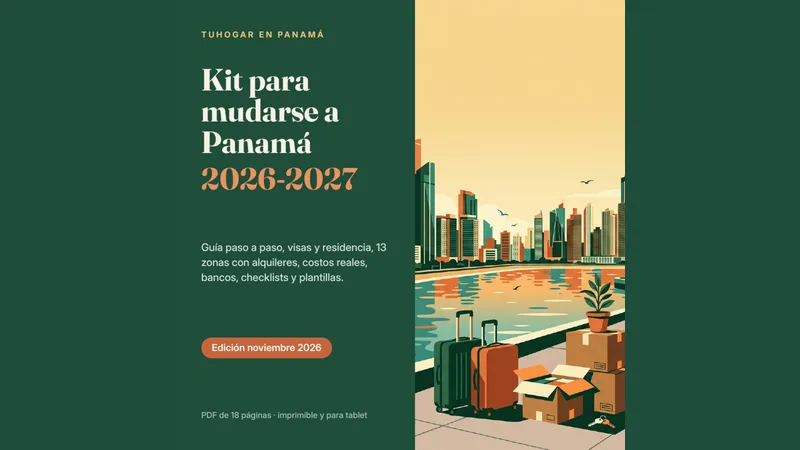 Living in Panama Kit 2026-2027 · US$19
The full guide to planning your move: visas and residency, neighborhoods with reference rents, real monthly costs, banking and checklists, in one PDF.
Sources
- DGI – Instructivo del Formulario 106 (ITBI, Ley 546 de 2026)
- DGI – Formulario 107, ganancia de capital
- DGI – Preguntas frecuentes de inmuebles
- DGI – Impuesto de inmuebles: tarifas y exoneraciones
- Gaceta Oficial 30264-A – Ley 468 de 2025 (interés preferencial)
General information with official sources; not legal or tax advice. Confirm amounts and requirements with the agency, your bank or a licensed attorney before signing.